
SEO is how injury firms get a steady flow of new cases. When someone is hurt, they open Google or AI. If you’re not visible, the case goes to someone else.
People trust search engines to guide their next step. Whether it’s “car accident lawyer near me” or “[city] injury lawyer,” those searches are happening every day in your area. Appearing in those moments positions your firm as the clear choice.
For 20 years, we’ve helped injury firms win online. No tricks—just authority, visibility, and showing up exactly when clients search. Done right, SEO turns a website into a reliable intake engine.
Before we get started, you’ll need to know where you stand and what needs to change to improve your rankings, so take advantage of this FREE SEO Audit.
SEO for personal injury lawyers is the process of making your firm’s website more visible in Google so that potential clients can find you when they need help. It’s not about tricks or shortcuts—it’s about building a clear, authoritative presence that search engines recognize and clients trust.
Personal injury law is one of the most competitive areas in search because the cases are high-value and the demand for representation is constant. Firms that take SEO seriously don’t just compete—they dominate their markets by consistently appearing where their best cases begin: on Google.
Google’s job is to connect people with the most useful, relevant information. To do that, it uses automated programs—often called crawlers or bots—that scan the internet, discover new pages, and add them to Google’s index. Once pages are indexed, Google applies its algorithm to decide which results should appear first for a given search.
Google’s Search Generative Experience (GSE) is changing how people see results. Instead of only showing a list of blue links, Google now provides AI-generated answers at the very top of the page. This means your firm’s visibility depends not only on traditional SEO signals, but also on how well your content is structured, authoritative, and comprehensive enough to be pulled into those AI-driven answers.
Law firms that want to compete must optimize for both traditional rankings and this new AI layer. Done correctly, that puts your firm in front of potential clients at the exact moment they’re asking for help—whether they see you in the organic listings, in Maps, or in Google’s AI-powered results.

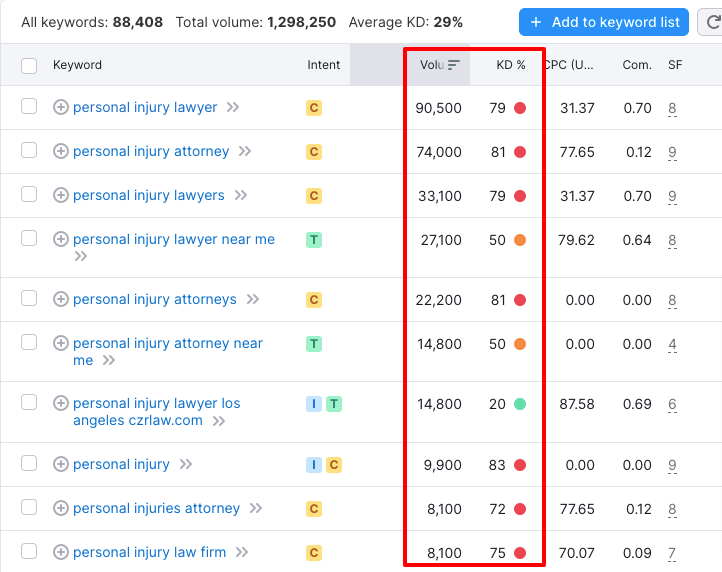
Every effective SEO strategy for personal injury law firms begins with the right keywords. These are the exact phrases potential clients type into Google when they’re searching for answers, guidance, or legal representation. If your website isn’t aligned with those searches, it won’t appear in the moments that matter most—and those cases will go to another firm.
Keyword research isn’t guesswork. It’s a data-driven process that requires advanced SEO tools like Semrush, Ahrefs, or Moz. These platforms give us a clear picture of the terms people are searching, how competitive those terms are, and which opportunities will deliver the most qualified leads for your practice. By analyzing this data, we build a keyword strategy that ensures your firm is visible for the searches that actually bring in new clients.
Every keyword we target is evaluated using two key metrics:
The key is balance. High-volume keywords bring broad visibility, while carefully chosen niche terms often generate the most qualified leads. By combining both, we create a keyword strategy that not only drives traffic but also delivers the types of cases that grow your firm.
When this process is done correctly, your site stops being invisible and starts showing up for the exact searches that lead to consultations, signed clients, and meaningful growth for your practice.
On-page SEO is where your website stops being a digital brochure and starts becoming a client-generating machine. It’s the process of optimizing every visible element of your site so Google understands who you are, what you do, and rewards you with higher rankings. For personal injury lawyers, this is where the foundation is laid to capture valuable cases before your competitors do.
Title tags are the clickable headlines that show up in Google search results. They’re one of the most important signals Google uses to understand your page—and one of the biggest factors clients use when deciding who to click. For personal injury firms competing in crowded markets, the difference between “average” and “optimized” title tags can mean hundreds of lost or gained cases a year.
Here’s what makes a strong title tag:
Example of an optimized title tag: “Dallas Personal Injury Lawyer – Free Case Review Today.”
Example of a weak title tag: “Home” or “Welcome to Our Law Firm.”
We craft title tags that both satisfy Google and persuade clients, so your firm earns more clicks—and more cases—from the same search rankings.
Meta descriptions don’t directly change where you rank, but they do change how many people choose your firm once they see you in the results. They’re the 1–2 sentence previews under your title, and when written well, they can double your click-through rate.
Why meta descriptions matter:
Example of an effective meta description:
“Looking for a car accident lawyer in Chicago? Our team has helped hundreds of victims recover compensation. Call today for a free consultation.”
Example of a poor meta description:
“Law firm website. Click here to learn more about our services.”
We write every meta description to highlight your expertise, feature your keywords, and compel potential clients to act—so more impressions turn into consultations.
Headers are the structured subheadings (H1, H2, H3) that organize your content. They aren’t just formatting—they guide both Google and visitors through your page. Without them, even strong content can feel overwhelming and unrankable.
Here’s why headers matter for injury firms:
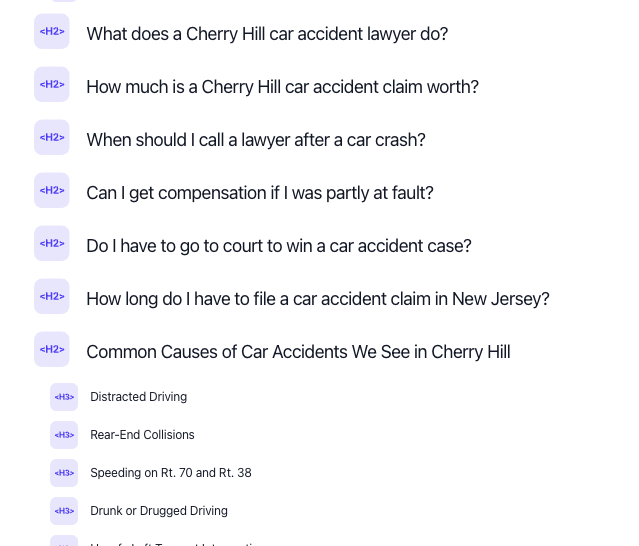
Example of optimized headers for a Car Accident Lawyer page:
When headers are optimized, clients stay on your site longer because it’s easy to follow, and Google rewards your page with stronger rankings. It’s a win on both fronts: better user experience and better visibility in search.
URLs aren’t just web addresses—they’re signals of trust, relevance, and professionalism. A clean URL instantly tells both Google and potential clients what the page is about. On the other hand, cluttered URLs with random numbers, symbols, or filler words confuse search engines and diminish credibility with visitors.
What makes a strong URL for personal injury lawyers?
Example of an optimized URL:
yourfirm.com/new-york-slip-and-fall-lawyer
Example of a poor URL:
yourfirm.com/page?id=1284&cat=personal_injury
Clean, keyword-rich URLs help your firm by:
Internal links are the pathways that connect one page of your website to another. For clients, they create a seamless journey—from reading a blog post that answers a common question to landing on a practice area page where they can contact your firm. For Google, internal links reveal which pages are most important and ensure your entire site gets indexed properly.
Think of internal linking as the wiring system of your website. Done right, it spreads SEO “juice” across your pages, ensuring that high-value content like your car accident or wrongful death pages receive maximum authority.
Benefits of a strong internal linking strategy include:
Example: A blog post titled “What to Do After a Rear-End Collision” links directly to your “Car Accident Lawyer in Chicago” page. This tells Google the pages are connected, and it guides the reader from information to action.
External links—links from your site to other trusted websites—may feel counterintuitive, but they build credibility and authority. By connecting your content to authoritative medical, legal, or government sources, you signal to both Google and potential clients that your information is accurate and trustworthy.
Examples of valuable external links for injury firms:
The benefits of external links include:
With strong external links, your website doesn’t just appear in search results—it earns authority. That authority is what helps clients feel confident reaching out, and what convinces Google to rank your firm above competitors.
Technical SEO is the behind-the-scenes foundation that makes your website fast, secure, and easy for Google to understand. Even if your content is excellent, hidden technical issues can bury your site in search results. For personal injury firms in competitive markets, technical SEO is often the deciding factor between a website that just exists and one that consistently drives new cases.
Yes—speed is critical. A law firm’s website has to do more than look professional; it has to perform flawlessly. Potential clients will abandon a slow-loading site within seconds, and Google factors speed directly into rankings. Fast, responsive sites earn more trust and more leads.
What we do to improve site speed:
Example: A car accident page that loads in under two seconds is far more likely to keep a visitor engaged long enough to fill out your contact form.
A clear site structure acts like a roadmap for both users and search engines. When Google can easily crawl and categorize your pages, it knows how to match them to search queries. For clients, an intuitive structure ensures they can quickly find answers without frustration.
Key elements of strong site structure include:
Security is non-negotiable. Injury victims often share sensitive details through your website, and HTTPS ensures that data is encrypted and protected. Google also favors secure sites in search results, meaning HTTPS impacts both trust and rankings.
Without HTTPS, browsers may even warn visitors that your site is “Not Secure,” which can immediately drive them away. We make sure every site we manage is fully secured and optimized to meet Google’s standards.
Beyond speed, structure, and security, technical SEO covers several behind-the-scenes essentials:
When technical SEO is done right, your firm’s website runs smoothly, ranks higher, and provides clients with a seamless experience from the first click. It’s the invisible work that delivers very visible results—more traffic, more trust, and more signed cases.
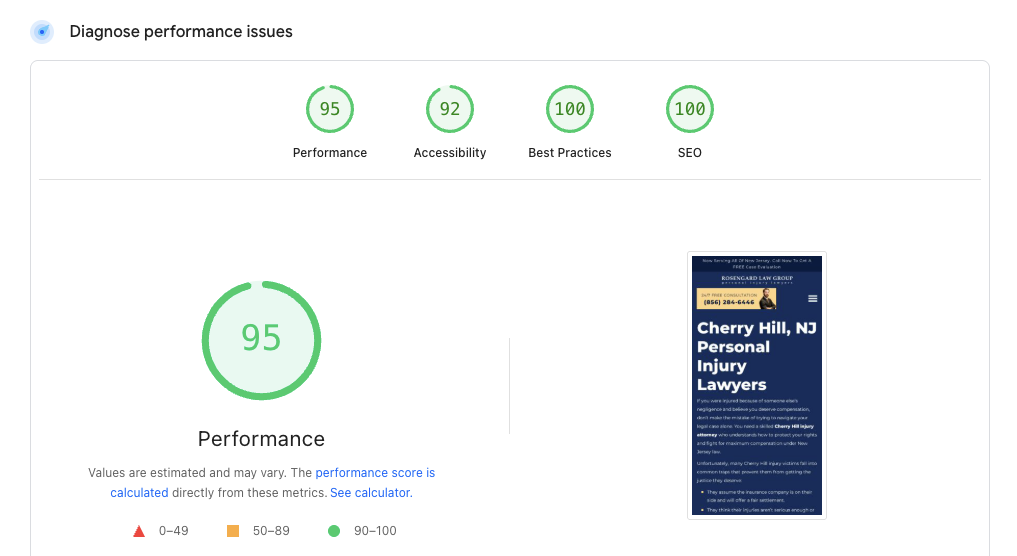
Your technical SEO scores should look like this:
Backlinks are one of the most powerful signals Google uses to decide which law firms deserve top rankings. For personal injury lawyers, strong links mean visibility, credibility, and ultimately, more signed clients. Without them, even the best-looking website can get buried beneath competitors.
Backlinks function like endorsements from other websites. When respected legal, medical, or local news sites link to your firm, they pass along trust that Google recognizes—and so do potential clients. These links don’t just improve rankings; they make your firm look established, credible, and safe to hire.
Example: Imagine two injury firms with nearly identical websites and content. The firm with backlinks from legal directories, local press, and professional associations will almost always outrank the other. That authority tells Google, and clients, “this firm is the stronger choice.”
Not all backlinks are created equal. In fact, the quality of your links matters far more than the quantity. The right approach builds long-term authority, while the wrong one can cause lasting damage.
Safe link practices include:
Risky link practices include:
The risk with shortcuts? Google penalties can bury your site in search results for years. That’s why law firms need link strategies built on quality, not quantity.
Google doesn’t treat all links the same. It evaluates quality based on:
Every link is judged by these standards. The stronger the signals, the more power the backlink carries for your site.

In SEO for personal injury lawyers, the best backlinks come from credible, relevant sources. Here are the strategies that drive the biggest impact:
Link building isn’t a one-time project—it’s an ongoing process. In competitive markets like personal injury law, authority compounds over time. The stronger the links you build, the more difficult it becomes for competitors to catch up.
Here’s why consistency matters:
The firms that rank for the biggest, most profitable cases are usually the ones that have been building links consistently over time. With the right strategy, your firm can secure that same level of visibility, credibility, and growth.
Content is what turns searches into signed cases. Even a technically perfect site won’t generate qualified leads without pages and articles that answer real client questions, demonstrate authority, and position your firm as the obvious choice to call.
Result: Coverage for both “ready to hire” and “researching” audiences—capturing more demand across the entire decision timeline.
When your content removes uncertainty, Google rewards the page with visibility—and clients reward you with calls and consultations.
We align every page to the intent behind the query so Google sees a perfect match—and clients find exactly what they came for.
When your content matches what people want to know and what Google wants to show, your firm earns steady traffic, stronger visibility, and a dependable flow of qualified leads—directly from your website.
These are examples of good H2/H3 tags:
For SEO for personal injury lawyers, winning locally is what drives real cases. Most clients look for representation near where the accident happened, and Google prioritizes nearby firms in its results. If your firm isn’t visible in local search, the calls go elsewhere.

Your Google Business Profile is the centerpiece of local visibility. It powers your presence in Google Maps and the local Map Pack—and it’s often where prospects decide to call. We fully optimize and manage your GBP so it works like a local lead engine.
The result is simple: your firm shows up more often in local searches, appears prominently in Google Maps, and earns more calls from clients in your service area—right when they’re ready to hire.
For personal injury law firms, Google Maps is some of the most valuable digital real estate available. The “local map pack”—the three results that show up at the very top of Google when someone searches for terms like “personal injury lawyer near me”—captures a massive share of clicks and phone calls. If your firm isn’t appearing there, competitors are taking the cases instead.
Ranking well in Maps isn’t random. Google evaluates businesses based on three core factors:
Citations play a critical role here. These are consistent listings of your firm’s name, address, and phone number (NAP) across directories and business sites. When Google sees that your information is the same everywhere, it builds trust and strengthens your Maps rankings.
Beyond the basics, your profile also benefits from ongoing activity. High-quality photos, video tours of your office, a well-managed Q&A section, and frequent updates all send signals to Google that your firm is active and engaged. These details don’t just help rankings—they also convince potential clients they’re choosing a professional, trustworthy law office.
The real advantage comes from being in the top three. Clients rarely click “more places”—they choose from the firms Google highlights first. Because Maps results include click-to-call buttons and directions, they often convert better than traditional organic search results. That means more direct calls to your office and more consultations with qualified leads in your local market.
Google’s Search Generative Experience (SGE) is changing how people see results. Instead of showing only blue links, Google now generates AI-powered answers at the very top of the page. For law firms, this means visibility isn’t limited to traditional rankings—you can also appear directly inside these AI summaries.
When someone searches “What should I do after a car accident?” or “How much is my slip and fall case worth?”, the first thing they now see may be an AI-generated answer—not a list of law firm websites. If your content isn’t structured and authoritative enough to be pulled into that answer, your firm risks being invisible in the very moments clients are making decisions.

To be featured in AI-driven results, your website needs more than keywords. Google favors pages that directly answer real client questions in clear, structured formats. Practice area pages, FAQ blocks, and authoritative blog posts all increase your chances of being cited in AI responses.
Content that mirrors how clients actually ask questions—short, direct answers supported by trustworthy details—positions your firm as the resource Google trusts.
Generative Engine Optimization (GEO) is the process of tailoring your SEO strategy for Google’s AI and SGE environment. Instead of focusing only on organic rankings, GEO makes your content eligible to appear in AI-generated responses, where visibility is highest and competition is toughest.

If a potential client asks Google AI, “How much is a car accident case worth in [City]?”, a detailed, locally relevant explanation on your site can be featured in the AI summary—placing your firm in front of that client before they even see the list of websites.
GEO is the next frontier in SEO for personal injury lawyers. Firms that adapt early will secure prime visibility in AI-powered search, while those who ignore it risk being left behind. Preparing now ensures your expertise shows up wherever clients are searching—whether in traditional results, Google Maps, or AI answers at the very top of the page.
The true measure of SEO for personal injury lawyers isn’t just rankings—it’s the number of new leads and signed clients your firm brings in. High positions in Google only matter if they translate into consultations, calls, and cases. That’s why tracking the right metrics is essential.
At the end of the day, your firm’s website is an engine for growth. Visibility in Google is valuable, but the end goal is always new cases. A strong SEO strategy ensures that traffic to your site turns into real inquiries from people who need representation, and ultimately into signed clients who fuel your practice.
To understand how well SEO is working, we track the metrics that connect directly to business outcomes:
We use a mix of tools to give you clear visibility into results:
When these metrics are tracked together, you get a full picture: how often your firm is being found, how much qualified traffic you’re receiving, and—most importantly—how many of those interactions turn into real clients. That’s the bottom line of effective SEO for injury firms.
SEO for personal injury lawyers is one of the most competitive areas in digital marketing. Success requires more than a few tweaks—it takes a strategy, careful execution, and ongoing effort. That’s where we come in.
We’ve guided injury firms through every step of this process: building strong technical foundations, creating content that attracts qualified clients, and developing authority that competitors can’t easily match. The result is consistent visibility in Google, steady growth in leads, and more signed cases for your firm.
SEO is not a do-it-yourself project. It requires expertise, specialized tools, and a clear roadmap to stay ahead in markets where every case counts. By partnering with us, you get a team that handles the details—from on-page optimization to link strategies to local and AI-driven search—so you can focus on running your practice.
If you’re ready to see how your firm can improve its rankings and start bringing in more clients from Google, the first step is simple. Request a free SEO audit and consultation. We’ll show you where you stand today, identify opportunities for growth, and outline a strategy tailored to your market.
Your next clients are searching right now. Let’s make sure they find you first.
SEO for personal injury lawyers is the process of improving your firm’s visibility on Google so potential clients find you when they search for legal help. It includes on-page optimization, technical fixes, link building, content creation, and local SEO strategies built specifically for law firms.
Most injury clients start their attorney search online. If your firm isn’t visible in Google search or Maps, those cases go to competitors. SEO ensures you appear for high-value searches like “car accident lawyer near me” so your firm becomes the first choice.
Most firms notice improvements in 3–6 months, but SEO compounds over time. In competitive markets, it can take 6–12 months to dominate, depending on your starting point, competition, and authority-building efforts like backlinks.
Paid ads stop the moment you stop spending. SEO builds a lasting presence that keeps bringing in clients without ongoing ad costs. Ads are short-term fuel; SEO is a long-term engine that delivers sustainable, compounding growth.
Yes. SEO connects you directly with people actively searching for an attorney. When your firm shows up at the top of Google, that visibility turns into phone calls, consultations, and signed cases.
Local SEO helps your firm appear in Google Maps and “near me” searches. Because most personal injury clients hire attorneys close to where accidents happen, ranking locally is critical for capturing those leads before competitors do.
Backlinks are links from other trusted websites. Google treats them like endorsements: the more quality links your firm earns from legal directories, medical sites, or local news outlets, the more authority and visibility you gain in search.
Content is what answers client questions and signals authority to Google. Practice area pages target high-intent searches (e.g., “Los Angeles car accident lawyer”), while blogs cover FAQs like “How long does it take to settle a case?” Together, they attract traffic and build trust.
Generative Engine Optimization (GEO) prepares your site for Google’s AI search results (SGE). Structured, comprehensive content increases your chances of being pulled into AI-generated answers at the top of search results, giving your firm visibility before clients see traditional links.
We track rankings, impressions, traffic, and most importantly, leads. Using Google Search Console, analytics, and call tracking, you’ll see exactly how SEO translates into new consultations and signed clients.
In highly competitive cities, it can take 6–12 months of steady SEO work—building content, earning backlinks, and optimizing technical factors—before your firm dominates the most valuable keywords. The payoff is long-term visibility and a pipeline of high-value cases.
Google’s Search Generative Experience pulls from content it considers authoritative, well-structured, and relevant. That means law firm websites with in-depth practice area pages, clear FAQs, trusted backlinks, and consistent local authority have the best chance of being featured in AI-driven answers.